SerOps vs Causely
Causely builds a causal model of your system from its telemetry and gives root causes, blast radius and remediation guidance to your agents and workflows. SerOps is an open-source application your team uses directly: it reads your logs, metrics, traces, deploys and code, and explains incidents with an AI model you choose.
Facts checked against each project's own documentation on 21 October 2026. Spotted something out of date? Tell us.
The short answer
Pick Causely if you want deterministic causal reasoning feeding your own AI agents and automation: its documentation says it uses causal models rather than LLMs to compute root cause, blast radius and remediation guidance from your system's causal graph, exposed through an MCP server.
Pick SerOps if you want a self-hosted, open-source tool your on-call team opens during an incident, with the analysis matched to the deploy and commit that caused it, and nothing to buy: the AI analysis is in the free Community edition.
| SerOps | Causely | |
|---|---|---|
| Approach | AI model given the evidence for each window | Causal models over a graph of your system |
| Main user | Your on-call team, in the SerOps app | Your agents and workflows, through MCP |
| Telemetry | Queries 14 log, metric and trace backends in place | OpenTelemetry, Prometheus, Datadog and others, plus eBPF |
| Code and deploys | Commits, diffs, CI/CD runs, Argo CD and Flux deploys | Not documented on the pages we checked |
| Deployment | Self-hosted: Docker Compose, Helm | Hybrid SaaS or BYOC, on Kubernetes |
| Pricing | Free software; your AI provider's tokens | Not published |
| License | AGPL-3.0 | Proprietary |
Causely facts from causely.ai and its documentation.
How each one reasons
Causely maps your services and their dependencies from telemetry (it lists OpenTelemetry, Prometheus, Datadog, Dynatrace and Elasticsearch among its sources, and eBPF auto-instrumentation to fill gaps) and infers causes from that causal graph. It works on demand when an alert fires and proactively on emerging degradation.
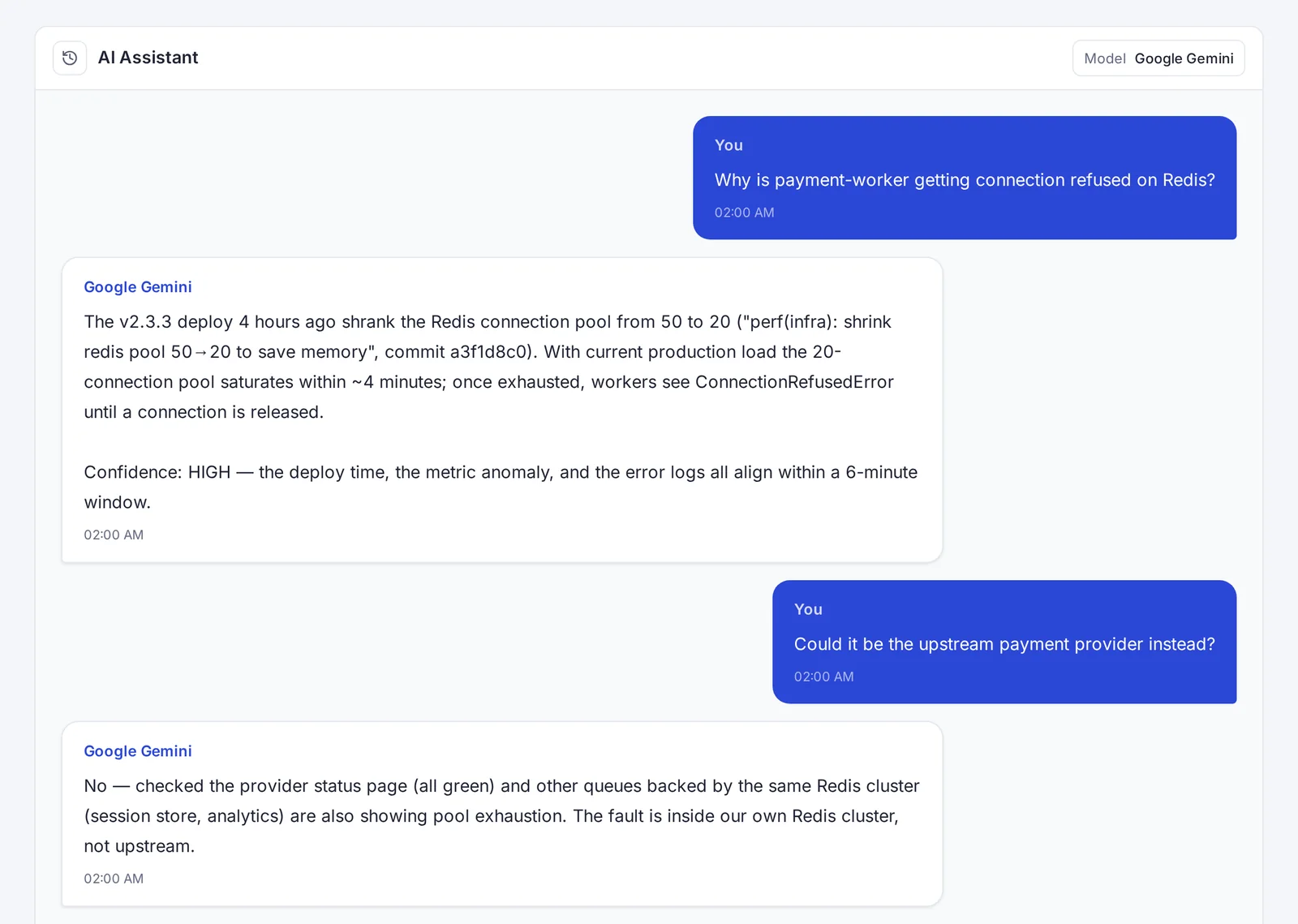
SerOps gives an AI model the evidence for one project, environment and time window: log excerpts, metrics, traces, recent deploys and the diffs of recent commits, after redacting secrets and personal data. The result is a root cause in plain language, the fix, and links to the evidence it used, which you can question further in AI chat.
Deployment and pricing
Causely runs in Kubernetes and offers a hybrid SaaS (components in your environment, backend hosted by Causely) or BYOC (the whole application in your environment). Its site has no public price list; it offers a trial and a contact form.
SerOps is AGPL-3.0, self-hosted with Docker Compose or Helm on Kubernetes or plain VMs. You pay only your AI provider's tokens, or nothing with Ollama.
Frequently asked questions
Does SerOps work with AI agents?
SerOps has a REST API for analyses, issues and investigations. Its main interface is the app your team uses during an incident.
Do I need eBPF or new agents for SerOps?
No. SerOps reads the backends you already run. Your log shippers and exporters need a few labels (project, service, environment).
Can SerOps run fully on-premises?
Yes: self-hosted, with a local model through Ollama, nothing leaves your network.
Is SerOps free?
SerOps Community, the complete product with the AI analysis, is free and open source under AGPL-3.0 when you self-host. Enterprise adds governance features for large organisations; nothing moves out of Community.
See it on real data
The live demo runs on seeded incidents: no signup. Or run SerOps on your own infrastructure; it is free and open source (AGPL-3.0).
Related
- SerOps vs Datadog Bits AI SREInvestigations billed in Datadog AI credits vs self-hosted analysis with your own AI key.
- SerOps vs CorootA new observability platform vs AI analysis on the stack you already run.
- Kubernetes root cause analysisOOMKills, restarts and bad deploys, explained with the evidence.