SerOps vs K8sGPT
K8sGPT scans your Kubernetes objects and explains what is misconfigured or failing. SerOps reads the logs, metrics, traces, deployments and code changes around an incident and explains why it happened. They answer different questions, and many teams can use both.
Facts checked against each project's own documentation on 17 October 2026. Spotted something out of date? Tell us.
The short answer
Pick K8sGPT if you want a fast CLI that tells you which pods, services, ingresses or PVCs are broken in a cluster right now, in plain English. It is a popular open-source project (Apache 2.0), works from your terminal, and its operator can keep scanning in the background.
Pick SerOps if your question is "why did checkout start failing at 14:05?". SerOps correlates application logs, metrics, distributed traces, the deploy that went out and the commits in it, and writes a root cause with the evidence, even when no alert fired. It also works outside Kubernetes.
| SerOps | K8sGPT | |
|---|---|---|
| Main question | Why did this incident happen? | What is broken in my cluster? |
| Data | Logs, metrics, traces, deploys, commits, CI/CD; Kubernetes OOMKills and restarts | Kubernetes objects and events; optional log analyzer |
| Runs | Continuously (every 15 min by default), on demand, or on alert | CLI on demand, operator in the background, or server mode |
| Outside Kubernetes | Yes: VMs, managed services, any app whose logs you collect | Kubernetes only |
| Interface | Web app, REST API, notifications | CLI, operator, MCP server |
| AI providers | Claude, OpenAI, Gemini, DeepSeek, Ollama (local) and custom endpoints | OpenAI, Azure OpenAI, Gemini, Bedrock, Cohere, LocalAI/Ollama and more |
| Data protection | Secrets and personal data masked before anything reaches the AI | Optional anonymization before the AI call |
| License | AGPL-3.0 | Apache 2.0 |
K8sGPT facts from its README.
What each tool looks at
K8sGPT is built around analyzers for Kubernetes resources: Pod, Deployment, ReplicaSet, Service, Ingress, StatefulSet, Job, CronJob, Node, PVC, Events and more, with optional analyzers for HPA, network policies, logs and security. Each analyzer applies SRE rules to the object's state, and an LLM turns the findings into an explanation.
SerOps starts from your observability data. It queries the log backend you already run (Elasticsearch, OpenSearch, Loki, Splunk, Datadog, CloudWatch, Google Cloud Logging or Azure Monitor), the metric backend (Prometheus, VictoriaMetrics, Mimir and others), traces over OpenTelemetry, and the deploy and code history from GitHub, GitLab, Bitbucket, Azure DevOps, Jenkins, Argo CD or Flux. On Kubernetes it also reads OOMKills and container restarts from kube-state-metrics, so a pod that ran out of memory is named as the cause instead of showing up as a mysterious dependency timeout.
How analysis runs
- K8sGPT: on demand with
k8sgpt analyze, continuously with the K8sGPT operator, or as a server (gRPC/HTTP). It also exposes an MCP server for AI assistants. - SerOps: continuously, every 15 minutes by default, on every project and environment. Sentinel checks each window first and skips the AI call when nothing changed (no anomaly, deploy or new error), which keeps AI cost low. You can also investigate any time window on demand, or forward Alertmanager, Grafana or Datadog alerts for an immediate analysis.
What you get out
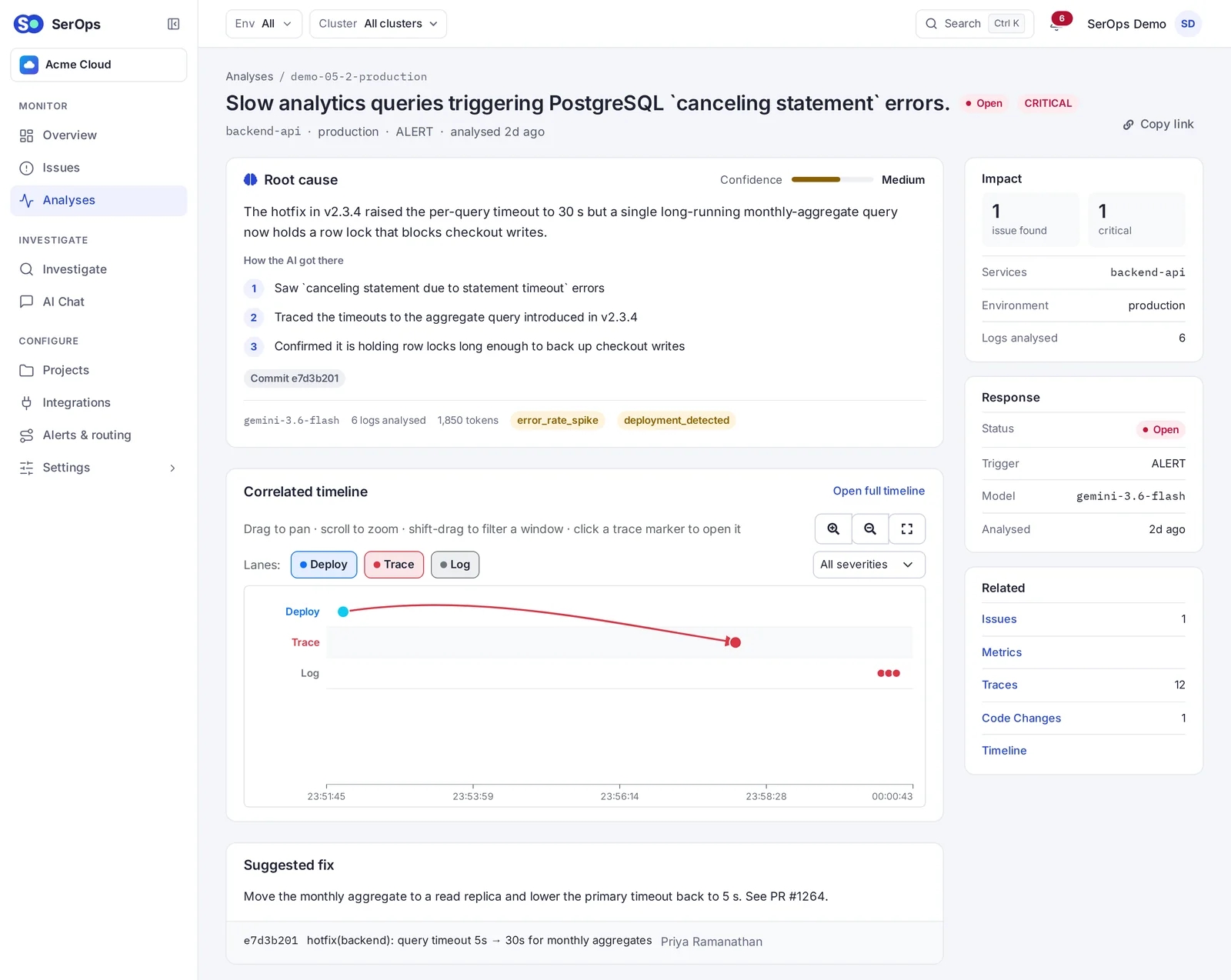
K8sGPT returns a list of problems per resource, in the terminal or through its integrations. SerOps gives you a web app: deduplicated issues with severity, root cause, a recommended fix and the evidence behind them, the deploy or commit they correlate with, similar past incidents, and a drafted post-mortem. Root causes can go to Slack, Teams, PagerDuty, OpsGenie or email.
Frequently asked questions
Can I use SerOps and K8sGPT together?
Yes. K8sGPT is handy for checking a cluster's health from the terminal; SerOps explains incidents across the whole stack over time. They don't overlap much.
Does SerOps need Kubernetes?
No. It runs on Docker Compose or Kubernetes, and analyses any workload whose logs and metrics you already collect. On Kubernetes it adds pod-level signals such as OOMKills and restarts.
Can SerOps run with a local model like K8sGPT can?
Yes. SerOps supports Ollama, so the whole analysis can stay inside your network.
Is SerOps free?
Yes. Every feature is free and open source under AGPL-3.0 when you self-host. You pay only your own AI provider, or nothing with a local model.
See it on real data
The live demo runs on seeded incidents: no signup. Or run SerOps on your own infrastructure; it is free and open source (AGPL-3.0).