SerOps vs HolmesGPT
HolmesGPT is an AI agent that investigates an incident by querying your tools step by step. SerOps runs root cause analysis continuously across logs, metrics, traces and deploys, and keeps the results as issues you can track. Both are open source and both can run with local models.
Facts checked against each project's own documentation on 17 October 2026. Spotted something out of date? Tell us.
The short answer
Pick HolmesGPT if you want an investigation agent you can point at an alert or a question, with a very wide set of toolsets (50+ data sources) and the option to post findings to Slack or open a pull request. It is a CNCF Sandbox project, started by Robusta with contributions from Microsoft (Apache 2.0).
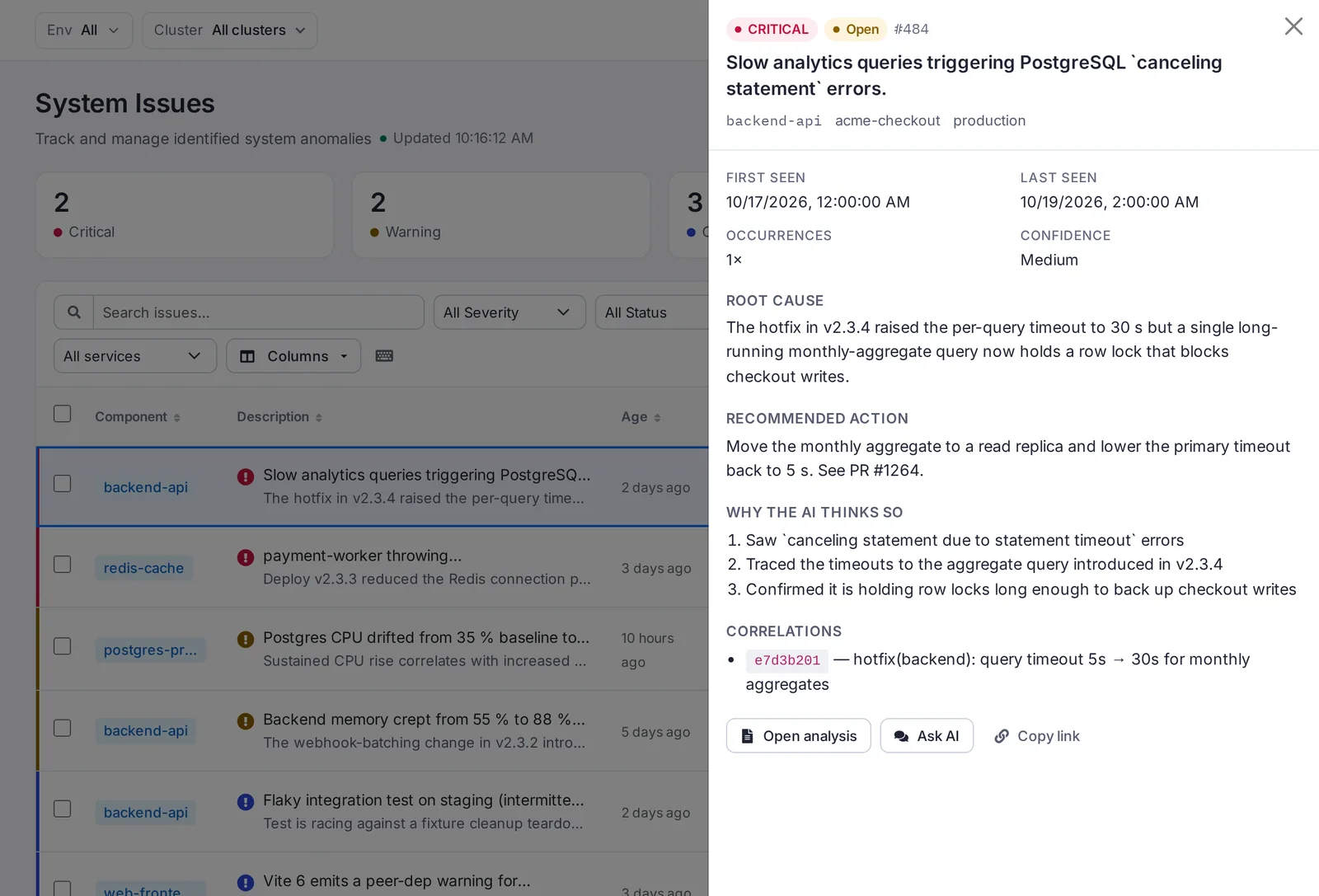
Pick SerOps if you want analysis that runs on its own, on every project and environment, and turns into tracked issues: deduplicated, with severity, root cause, recommended fix, the deploy or commit they correlate with, and a history you can search. SerOps also finds incidents nobody wrote an alert for.
| SerOps | HolmesGPT | |
|---|---|---|
| Approach | Fixed analysis pipeline per time window | Agentic loop that calls tools |
| Runs | Continuously, on demand, or on alert | On demand (CLI, Slack, alerts) or in the background (operator) |
| Finds incidents with no alert | Yes, every window is analysed | Through the operator's background checks |
| Results | Tracked, deduplicated issues with history; incident pages; post-mortem drafts | Answers and findings posted back to the caller, Slack or a PR |
| Deploy and code correlation | Built in: GitHub, GitLab, Bitbucket, Azure DevOps, Jenkins, Argo CD, Flux | Through the toolsets you enable |
| AI cost control | Sentinel skips quiet windows; monthly budget cap | Depends on the number of tool calls per investigation |
| Local models | Ollama | Ollama and OpenAI-compatible endpoints |
| License | AGPL-3.0 | Apache 2.0 (CNCF Sandbox) |
HolmesGPT facts from its README and documentation.
Agent loop vs analysis pipeline
HolmesGPT works as an agentic loop: the model decides which tool to call next (Prometheus, Loki, Kubernetes, Datadog and so on), reads the result, and continues until it has an answer. That makes it flexible, and the quality depends on the model and the toolsets you enable.
SerOps runs a fixed pipeline for each time window: collect logs, metrics, a trace summary and the code and CI/CD changes, deduplicate and detect anomalies, mask secrets and personal data, then ask the model once for a root cause in a strict JSON format. The result is predictable in cost and comparable between runs, and Sentinel skips the AI call entirely when a window is quiet.
Triggers
- HolmesGPT: CLI, Helm or Docker install, an operator that looks for problems in the background, Slack, and alerts from Alertmanager, PagerDuty or OpsGenie.
- SerOps: a schedule (every 15 minutes by default), on-demand investigations for any window up to 6 hours, and incoming alerts from Alertmanager, Grafana or Datadog, analysed in about 30 seconds.
Where the results live
HolmesGPT returns an answer to the person or system that asked, and can write findings back to Slack or other tools; a web UI is available as a third-party add-on. SerOps is a web application: a dashboard that opens on what needs attention now, an issues list with filters and a side panel, an incident page per analysis, AI chat over past analyses, and notifications to Slack, Teams, PagerDuty, OpsGenie or email.
Frequently asked questions
Is SerOps an AI agent?
Not in the tool-calling sense. SerOps collects the evidence itself and asks the model one structured question per window. That keeps the cost per analysis predictable and the results comparable over time.
Can I ask SerOps questions like I would ask HolmesGPT?
Yes, through AI chat, which answers from the analyses SerOps already ran. To look at fresh data, start an investigation for the window you care about.
Does SerOps send my logs to OpenAI?
Only if you choose OpenAI as the provider, and only after secrets and personal data are masked. With Ollama, nothing leaves your network.
Is SerOps free?
Yes, every feature is free and open source under AGPL-3.0 when you self-host.
See it on real data
The live demo runs on seeded incidents: no signup. Or run SerOps on your own infrastructure; it is free and open source (AGPL-3.0).